
Khula Procedure in Pakistan 2026: Complete Legal Guide, Requirements, Court Process & Relevant Laws
khula Procedure in Pakistan is a legal process through which a Muslim woman can seek dissolution of marriage through the Family Court when reconciliation is not possible. This process is governed by family laws in Pakistan. The Khula Procedure in Pakistan ensures that women can legally seek dissolution of marriage through Family Courts when reconciliation is not possible.
What Is Khula in Pakistan?
Khula is the dissolution of marriage initiated by a wife through the Family Court. Unlike Talaq, which is pronounced by the husband, Khula allows a woman to legally terminate her marriage through judicial proceedings.
Under Pakistani law, a woman may seek Khula when she feels that she cannot continue living with her husband within the limits prescribed by Islam and reconciliation between the spouses is no longer possible.
Laws Governing Khula Procedure in Pakistan
Several important laws regulate family matters and Khula proceedings in Pakistan.
1. Dissolution of Muslim Marriages Act, 1939
The Dissolution of Muslim Marriages Act, 1939 provides legal grounds through which Muslim women may seek dissolution of marriage. The Act protects women’s rights and establishes the legal framework for ending a marriage through judicial intervention.
2. West Pakistan Family Courts Act, 1964
The West Pakistan Family Courts Act, 1964 grants jurisdiction to Family Courts to hear and decide Khula cases.
Under this law, the Family Court is responsible for:
- Hearing Khula petitions
- Issuing notices to the husband
- Conducting reconciliation proceedings
- Recording evidence and statements
- Granting a decree of dissolution where appropriate
3. Muslim Family Laws Ordinance, 1961
The Muslim Family Laws Ordinance, 1961 regulates marriage registration, divorce registration, and family-related legal matters in Pakistan.
Following the grant of Khula, the dissolution process is completed through the relevant Union Council in accordance with applicable legal requirement.
Khula Procedure in Pakistan: Who Can Apply?
Any Muslim woman may file a Khula suit if:
- Reconciliation is not possible.
- Marital relations have irretrievably broken down.
- She no longer wishes to continue the marriage.
- She believes she cannot fulfil marital obligations.
- Serious incompatibility exists between spouses.
Step-by-Step Khula Procedure in Pakistan
Step 1: Consultation with a Family Lawyer
The first step is obtaining legal advice from an experienced family lawyer. Professional legal assistance helps ensure proper documentation and compliance with Family Court procedures.
Step 2: Preparation of Khula Suit
A Suit for Dissolution of Marriage is prepared and filed before the competent Family Court.
The petition generally includes:
- Marriage details
- Names of parties
- Grounds for Khula
- Information regarding Haq Mehr
- Information regarding children
Step 3: Filing Before Family Court
The Khula petition is filed before the Family Court having territorial jurisdiction over the matter.
After filing, the court issues summons to the husband.
Step 4: Service of Notice
The court ensures that legal notice is served upon the husband, informing him about the proceedings and hearing date.
Step 5: Reconciliation Proceedings
Under Pakistani family laws, Family Courts attempt reconciliation between the parties before proceeding with dissolution.
If reconciliation succeeds, the marriage may continue.
If reconciliation fails, the court proceeds with the case.
Step 6: Wife’s Statement Before Court
The wife records her statement before the judge explaining why she is unable to continue the marriage.
The court carefully considers her statement and surrounding circumstances.
Step 7: Decree of Khula
Where reconciliation fails and the court is satisfied that the marriage cannot continue, a decree for dissolution of marriage is granted.
This decree legally terminates the marriage.
Step 8: Union Council Proceedings
Following the Family Court decree, the matter is forwarded to the relevant Union Council for legal formalities and record purposes.
Step 9: Issuance of Divorce Certificate
After completion of the prescribed legal process, the relevant authority issues the Divorce Certificate confirming dissolution of marriage
Understanding the Khula Procedure in Pakistan is important for women to know their legal rights and complete the court process correctly.
Union Council Verification for Marriage and Khula Registration in Pakistan
In Pakistan, the Union Council is the primary local government authority responsible for registering and verifying family matters such as marriage (Nikah) and Khula (judicial divorce). Without Union Council verification, legal recognition of marriage or divorce is incomplete in official government records including NADRA.
What is Union Council Verification?
Union Council verification is the official process of confirming and recording marriage or divorce documents in the local government register. After verification, the data is forwarded to NADRA for computerized certification.
Marriage Verification Process in Union Council
After Nikah is performed, the Nikah Registrar submits the Nikah Nama to the Union Council for registration.
Steps include:
- Submission of original Nikah Nama
- Verification of CNICs of both spouses
- Confirmation of witness details
- Entry into official Union Council marriage register
- Forwarding data to NADRA
After Verification:
A Marriage Registration Certificate (MRC) is issued which is required for:
- NADRA Marriage Certificate
- Passport and visa applications
- Legal proof of marriage
- Updating marital status in CNIC
Khula Registration Process in Union Council
Khula is a court-based divorce initiated by the wife under family law in Pakistan. The Union Council is involved after the court issues its final decision.
Step-by-step process:
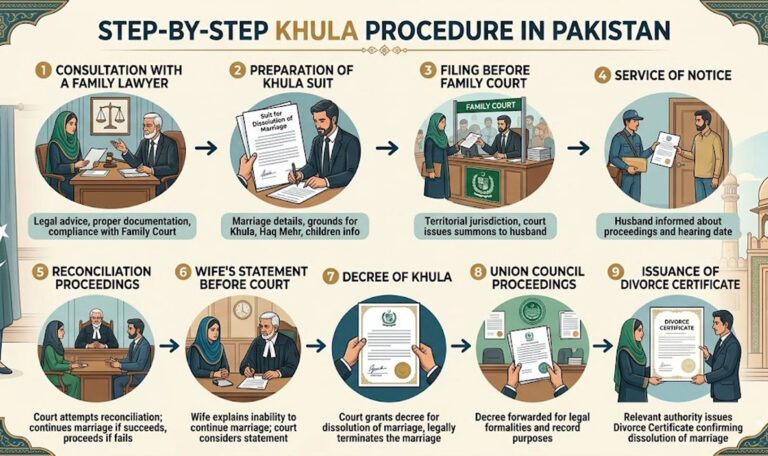
- Filing Khula case in Family Court
- Court reconciliation attempts
- Khula decree issued by court
- Submission of decree to Union Council
- Registration of divorce in official record
- Issuance of Divorce Certificate after iddat period Role of Union Council in Legal Documentation
Union Council ensures that all family-related legal changes are officially recorded and recognized by the state. It acts as a bridge between courts and NADRA.
Importance of Union Council Verification
- Legal recognition of marriage and divorce
- Required for NADRA certificates
- Protection in inheritance and family law matters
- Essential for official documentation updates
Documents Required for Khula Procedure in Pakistan
The following documents are commonly required:
- Wife’s CNIC
- Husband’s CNIC (if available)
- Nikah Nama
- Marriage Registration Certificatehttps://lgcd.punjab.gov.pk
- Passport-size photographs
- Proof of residence
- Power of Attorney (for overseas Pakistanis)
Additional documents may be required depending upon the facts of the case.
Khula in Pakistan Without Husband’s Consent
Yes.
One of the most frequently asked questions regarding Khula without Husband Consent is whether the husband’s approval is necessary.
Under Pakistani law, Family Courts may grant Khula even if the husband opposes the dissolution, provided reconciliation efforts have failed and the court is satisfied that the marriage cannot continue
How Long Does the Khula Process Take?
The duration varies depending on:
- Court workload
- Service of summons
- Attendance of parties
- Completion of legal formalities
Many cases conclude within a few months, although timelines vary from case to case
Rights of Women After Khula Procedure in Pakistan
After obtaining Khula, a woman is entitled to certain legal rights under Pakistani family law, depending on the facts and circumstances of the case. These rights are determined by the Family Court while keeping fairness and the welfare of all parties in view.
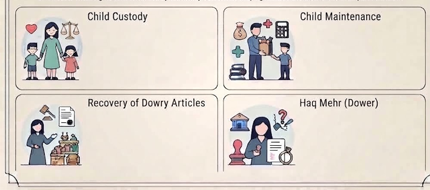
Child Custody
In matters of child custody, the Family Court primarily considers the welfare and best interests of the child. In most cases, custody of young children is granted to the mother, especially when they are of tender age. However, the final decision always depends on the overall circumstances, including the ability of each parent to provide proper care, education, and upbringing.
Child Maintenance
The father is generally responsible for the financial maintenance of his children even after Khula. This includes expenses related to education, healthcare, food, and general upbringing. The court determines the amount of maintenance based on the financial capacity of the father and the needs of the children.
Recovery of Dowry Articles
A woman has the legal right to claim the return of her dowry articles, gifts, and personal belongings given at the time of marriage. If these items are not returned voluntarily, she may approach the Family Court for recovery through legal proceedings. The court may order the husband or his family to return the lawful belongings.
Haq Mehr (Dower)
The treatment of Haq Mehr in Khula cases depends on the specific facts of each case. In some situations, the wife may forgo her claim as part of the Khula settlement, while in other cases, the court may decide the matter based on evidence and legal principles. Each case is evaluated individually to ensure a fair outcome.
Khula for Overseas Pakistanis
Pakistani women residing abroad may initiate Khula proceedings through authorized legal representation and a Special Power of Attorney.
This option provides a practical solution for overseas Pakistanis who are unable to attend court proceedings personally.
Difference Between Khula and Talaq in Pakistan
Khula and Talaq are both methods of dissolving a marriage in Islam and Pakistani family law, but they are legally and procedurally different.
Khula is a right of the wife, where she approaches the Family Court to seek dissolution of marriage when she is unable to continue the marital relationship. In Khula cases, the court evaluates the situation and may grant divorce even without the husband’s consent if reconciliation fails.
Talaq, on the other hand, is the right of the husband, where he pronounces divorce according to Islamic and legal procedures. In most cases, Talaq is processed through the Union Council after proper notice and legal waiting period.
Key Difference:
- Khula is initiated by the wife through Family Court
- Talaq is initiated by the husband
- Khula requires court involvement
- Talaq is usually processed through Union Council
- Khula may require returning Haq Mehr depending on court decision
Understanding the difference between Khula and Talaq is important for legal awareness and proper use of rights under Pakistani family law.
Why Legal Representation is Important
-
Family law disputes involve significant legal and personal consequences. An experienced family lawyer can:
- Prepare legal documents
- File the case correctly
- Represent clients before Family Courts
- Handle Union Council proceedings
- Protect legal rights throughout the process
For better understanding of marriage documentation, you can also read our Nikah Nama Registration article for detailed legal guidance.
For official guidance on legal procedures and family law matters, you can refer to government legal resources.
Legal Assistance for Khula Cases in Pakistan
If you are seeking professional legal support regarding the Khula Procedure in Pakistan, experienced legal representation can help you navigate Family Court proceedings smoothly and efficiently.
Advocate Uzair Rasheed and his legal team provide comprehensive legal assistance in all family law matters across Pakistan, ensuring proper legal guidance and representation before Family Courts.
Legal Services Include:
- Khula Cases (Dissolution of Marriage)
- Divorce Matters in Pakistan
- Family Court Litigation
- Child Custody Cases
- Child Maintenance Claims
- Recovery of Dowry Articles
- Online Marriage in Pakistan
- Overseas Pakistani Family Law Issues
- Legal Consultation and Court Representation
Office Information:
📍 Office: Lahore High Court, Lahore, Pakistan
📞 Phone: +92 307 4834430
✉️ Email: legalinformationworld@gmail.com
🌐 Website: www.legalinformation.asia
📺 YouTube: www.legalinformation.asia
Frequently Asked Questions
What is Khula in Pakistan?
Khula is a court-based dissolution of marriage initiated by a Muslim wife through the Family Court.
Which law governs Khula in Pakistan?
Khula is governed primarily by the Dissolution of Muslim Marriages Act, 1939, West Pakistan Family Courts Act, 1964, and Muslim Family Laws Ordinance, 1961.
Is the husband’s permission required for Khula?
No. Family Courts may grant Khula without the husband’s consent when reconciliation is unsuccessful.
Which court hears Khula cases?
Khula cases are heard by the Family Court having jurisdiction over the matter.
Can overseas Pakistani women apply for Khula?
Yes. Overseas Pakistani women may initiate proceedings through authorized legal representation and Power of Attorney.
How long does the Khula process take in Pakistan?
The Khula process usually takes around 1 to 3 months, depending on the court workload and case complexity.
Who issues the divorce certificate after Khula?
The Union Council issues the divorce certificate after receiving the Family Court’s Khula decree.
Does Union Council give Khula in Pakistan?
No, Khula is granted only by Family Court. Union Council only registers the court order.
Conclusion
The Khula Procedure in Pakistan provides women with a legally recognized method of dissolving a marriage through the Family Court. Understanding the relevant laws, legal requirements, court process, and documentation helps women protect their rights and make informed decisions.
If you require legal advice regarding Khula, Family Court proceedings, child custody, maintenance ,Court Marriage or marriage dissolution matters, professional legal assistance can help ensure compliance with Pakistani family laws and court procedures.
.
.
.