
Divorce Procedure in Pakistan 2026 Complete Legal Guide
Divorce Procedure in Pakistan is a legally regulated process governed primarily by the Muslim Family Laws Ordinance, 1961. Many people mistakenly believe that a verbal divorce is sufficient to end a marriage. However, Pakistani law requires specific legal steps to ensure that the divorce is valid and officially recognized. Understanding the Divorce Procedure in Pakistan helps protect the rights of both spouses and prevents future legal complications.
Whether you are a husband seeking Talaq, a wife pursuing Khula, or a couple considering mutual separation, this guide explains every important step in simple language.
What is Divorce Under Pakistani Law?
Divorce is the legal dissolution of marriage. In Pakistan, divorce can take place through:
- Talaq (Divorce by Husband)
- Khula (Divorce by Wife through Family Court)
- Talaq-e-Tafweez (Delegated Right of Divorce)
- Mubarat (Mutual Divorce by Agreement)
Each method follows specific legal procedures before a Divorce Certificate can be issued.
Legal Framework Governing Divorce Procedure in Pakistan
The Divorce Procedure in Pakistan is mainly regulated by:
- Muslim Family Laws Ordinance, 1961
- Family Courts Act, 1964
- Dissolution of Muslim Marriages Act, 1939
Section 7 of the Muslim Family Laws Ordinance is particularly important because it requires written notice to the Union Council and provides a mandatory reconciliation period.
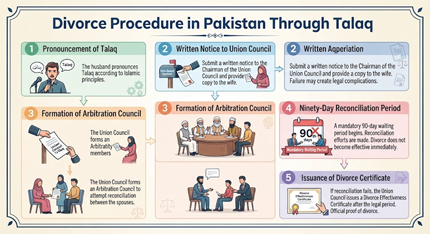
Divorce Procedure in Pakistan Through Talaq
When a husband wishes to divorce his wife, the following steps must be followed:
Step 1: Pronouncement of Talaq
The husband pronounces Talaq according to Islamic principles.
Step 2: Written Notice to Union Council
After pronouncing Talaq, the husband must submit a written notice to the Chairman of the relevant Union Council and provide a copy to his wife. Failure to do so may create legal complications.
Step 3: Formation of Arbitration Council
The Union Council forms an Arbitration Council to attempt reconciliation between the spouses.
Step 4: Ninety-Day Reconciliation Period
A mandatory 90-day waiting period begins from the date the notice is received. During this period, reconciliation efforts are made. The divorce does not become effective immediately.
Step 5: Issuance of Divorce Certificate
If reconciliation fails, the Union Council issues a Divorce Effectiveness Certificate after the completion of the legal period. This certificate serves as official proof of divorce.
Khula Procedure in Pakistan
A wife who wishes to end her marriage may file a Khula suit in the Family Court.
Steps for Khula
- File a Khula petition in Family Court.
- Attend court hearings.
- Court attempts reconciliation.
- Court grants Khula decree if reconciliation fails.
- Decree is sent to Union Council.
- Union Council completes legal formalities and issues the divorce certificate.
Documents Required for Divorce Procedure in Pakistan
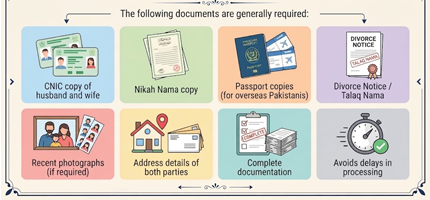
The following documents are generally required:
- CNIC copy of husband and wife
- Nikah Nama copy
- Passport copies (for overseas Pakistanis)
- Divorce Notice / Talaq Nama
- Recent photographs (if required)
- Address details of both parties
Having complete documentation helps avoid delays in processing.
Divorce Procedure for Overseas Pakistanis
Pakistani citizens living abroad can also initiate divorce proceedings without physically travelling to Pakistan. Through a Special Power of Attorney, a legal representative can complete the process on their behalf.
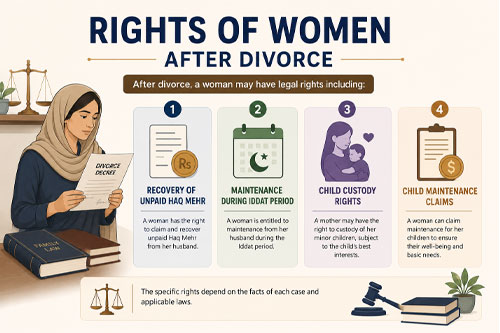
Rights of Women After Divorce
After divorce, a woman may have legal rights including:
- Recovery of unpaid Haq Mehr
- Maintenance during Iddat period
- Child custody rights
- Child maintenance claims
The specific rights depend on the facts of each case and applicable laws.
Child Custody After Divorce
Pakistani courts prioritize the welfare of the child when deciding custody matters. The court considers:
- Child’s age
- Educational needs
- Emotional well-being
- Financial stability of parents
- Best interests of the child
Custody decisions are always made according to the welfare principle.
Common Mistakes During Divorce Procedure in Pakistan
Many people face legal difficulties because they:
- Fail to notify the Union Council
- Do not maintain proof of notice delivery
- Ignore legal timelines
- Rely only on verbal divorce
- Misunderstand Khula requirements
Seeking proper legal guidance can prevent unnecessary disputes.
Why Legal Compliance is Important
A legally recognized divorce protects both parties from future complications relating to:
- Remarriage
- NADRA records
- Inheritance issues
- Immigration applications
- Child custody disputes
Following the correct Divorce Procedure in Pakistan ensures legal certainty and protects family rights.
Professional Legal Assistance for Divorce Procedure in Pakistan
Navigating the Divorce Procedure in Pakistan can be challenging, especially when dealing with legal notices, Union Council requirements, Divorce Certificates, overseas documentation, and family law matters. Professional legal guidance can help ensure that the process is completed correctly and efficiently.
Why Choose Uzair Rasheed Sandhu Advocate High Court?
Experienced Family Law Representation
Every divorce matter is supervised by Uzair Rasheed Sandhu Advocate High Court, ensuring compliance with Pakistani family laws, legal procedures, and Union Council requirements.
Support for Overseas Pakistanis
We provide comprehensive legal assistance to overseas Pakistanis seeking Talaq, Khula, Divorce Certificates, and related family law services without the need to travel to Pakistan.
Confidential and Reliable Services
All divorce and family matters are handled with complete confidentiality, professionalism, and dedication to protecting our clients’ legal rights.
Complete Divorce Documentation
Our legal team assists clients in obtaining legally valid Divorce Certificates and related documents required for remarriage, immigration, visa processing, and official record purposes.
Contact Uzair Rasheed Sandhu Advocate High Court
Don’t let legal complexities delay your right to divorce. Trust an experienced legal professional to manage your Divorce Procedure in Pakistan efficiently and legally.
📍 Office: Lahore High Court, Lahore, Pakistan
📞 Phone: +92 307 4834430
✉️ Email: legalinformationworld@gmail.com
🌐 Website: www.legalinformation.asia
Schedule a consultation today to discuss your divorce, khula, child custody, maintenance, or any other family law matter.
Frequently Asked Questions
What is the legal Divorce Procedure in Pakistan?
The Divorce Procedure in Pakistan requires the husband to send a written Talaq Notice to the relevant Union Council and provide a copy to the wife. The Union Council then initiates a 90-day reconciliation period before issuing a Divorce Certificate.
How long does the Divorce Procedure in Pakistan take?
In most cases, the divorce becomes effective after the completion of the mandatory 90-day reconciliation period required under Pakistani family law.
Is verbal Talaq legally sufficient in Pakistan?
No. Verbal Talaq alone is not enough for legal recognition. The husband must also submit a written notice to the Union Council according to the Muslim Family Laws Ordinance, 1961.
Can a wife apply for divorce in Pakistan?
Yes. A wife may seek dissolution of marriage through Khula by filing a petition before the Family Court if reconciliation is not possible.
What documents are required for divorce in Pakistan?
Generally, the required documents include CNIC copies of both spouses, Nikah Nama, divorce notice, passport copies (for overseas Pakistanis), and other supporting documents.
Can overseas Pakistanis complete the Divorce Procedure in Pakistan?
Yes. Overseas Pakistanis can initiate and complete divorce proceedings through a Special Power of Attorney and an authorized legal representative in Pakistan.
What is the role of the Union Council in divorce cases?
The Union Council receives the divorce notice, forms an Arbitration Council for reconciliation efforts, and ultimately issues the Divorce Effectiveness Certificate if reconciliation fails.
Can a divorce be cancelled during the 90-day period?
Yes. If the spouses reconcile during the 90-day waiting period, the divorce may be revoked according to applicable family laws.
Why is a Divorce Certificate important?
A Divorce Certificate serves as official proof of divorce and may be required for remarriage, immigration matters, visa applications, and legal record updates.
How can I obtain legal assistance for Divorce Procedure in Pakistan?
Individuals seeking guidance regarding Talaq, Khula, Divorce Certificates, Child Custody, or other family law matters may consult an experienced family lawyer to ensure compliance with all legal requirements.
Conclusion
The Divorce Procedure in Pakistan involves more than simply pronouncing Talaq. Pakistani law requires written notice, Union Council involvement, reconciliation efforts, and official certification before a divorce becomes legally effective. Whether the divorce occurs through Talaq, Khula, or mutual agreement, understanding the proper legal process helps safeguard the rights of all parties involved.
Individuals facing marital disputes should seek professional legal guidance to ensure compliance with Pakistani family laws and avoid future legal complications.