
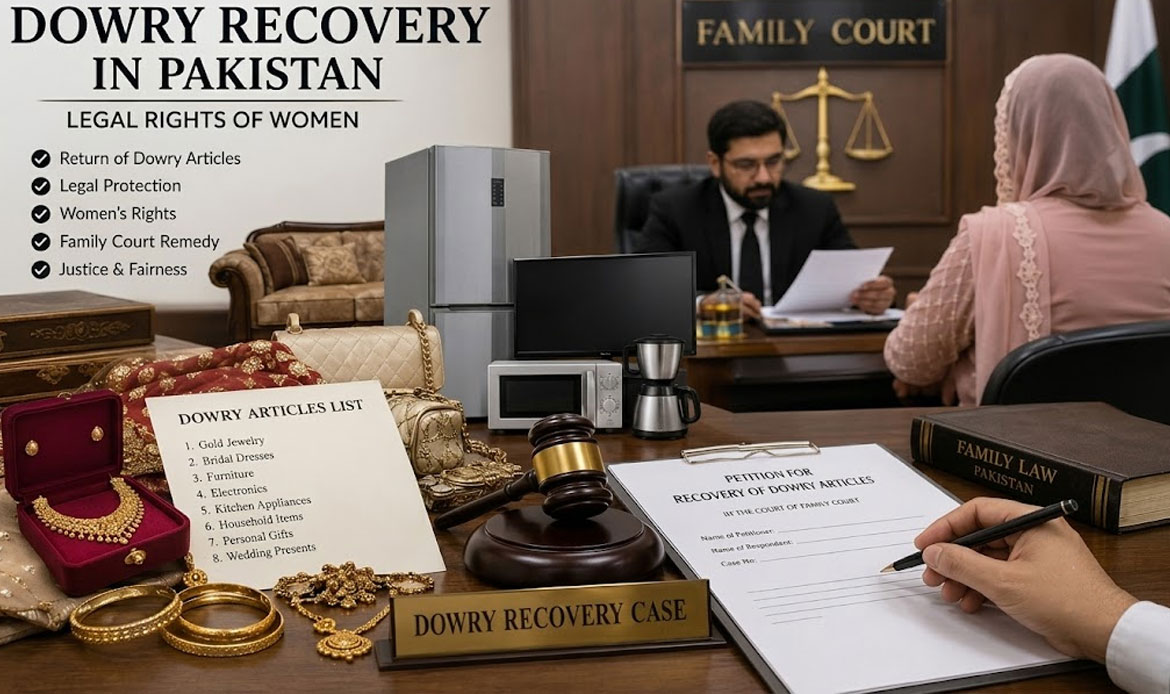
Dowry Recovery in Pakistan Complete Legal Procedure and Legal Rights
Dowry disputes are among the most common family law issues in Pakistan. When a marriage ends due to divorce, Khula, or separation, many women seek the return of their dowry items that were gifted by their parents and relatives at the time of marriage. Dowry Recovery in Pakistan is a legal right protected under Pakistani family laws, and courts can order the return of dowry articles or their market value.
This article explains the complete procedure for Dowry Recovery in Pakistan, legal requirements, required documents, evidence, court process, and important legal rights for public awareness.
What is Dowry Recovery in Pakistan?
Dowry Recovery refers to the legal process through which a wife seeks the return of dowry articles, gifts, jewelry, furniture, household items, and other valuables given to her at the time of marriage.
If the husband or his family refuses to return these items after separation, divorce, or Khula, the wife may file a suit for recovery before the Family Court.
Legal Basis for Dowry Recovery
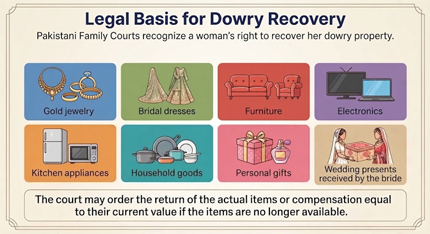
Pakistani Family Courts recognize a woman’s right to recover her dowry property.
Dowry articles may include:
- Gold jewelry
- Bridal dresses
- Furniture
- Electronics
- Kitchen appliances
- Household goods
- Personal gifts
- Wedding presents received by the bride
The court may order the return of the actual items or compensation equal to their current value if the items are no longer available.
When Can a Wife File a Dowry Recovery Case?
A wife may file a Dowry Recovery case when:
- Divorce has occurred.
- Khula has been granted.
- The spouses are living separately.
- The husband refuses to return dowry articles.
- The in-laws unlawfully retain dowry items.
- Dowry property has been damaged or sold.
The right to seek recovery exists regardless of whether the marriage has ended through divorce or Khula.
Documents Required for Dowry Recovery in Pakistan
To strengthen a Dowry Recovery claim, the following documents are helpful:
- CNIC Copies
Copies of the wife’s CNIC and other relevant identity documents.
- Marriage Certificate (Nikahnama)
A copy of the registered Nikahnama.
- Dowry List
A detailed list of dowry articles provided at the time of marriage.
- Purchase Receipts
Receipts for jewelry, furniture, electronics, and other valuable items.
- Wedding Photographs and Videos
Photographs often serve as evidence showing the dowry articles.
- Witness Statements
Relatives and other persons present during marriage ceremonies may testify regarding the dowry items.
To strengthen a Dowry Recovery claim, the following documents are helpful:
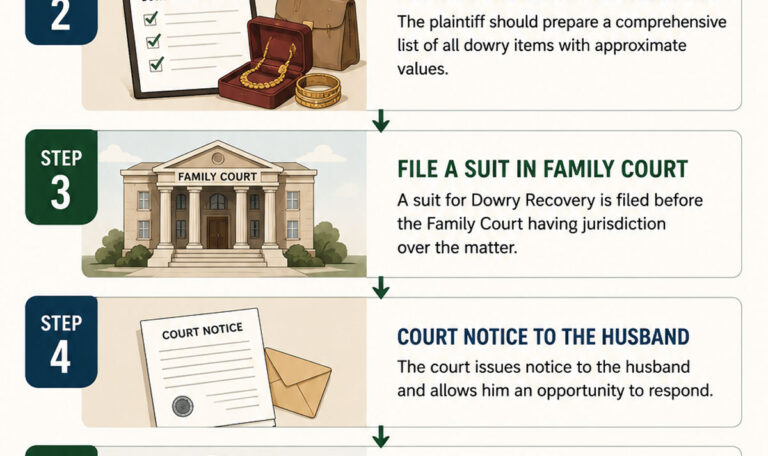
Procedure for Filing a Dowry Recovery Case
Step 1: Consult a Family Lawyer
A family lawyer can assess the available evidence and prepare the legal claim.
Step 2: Prepare the Dowry Articles List
The plaintiff should prepare a comprehensive list of all dowry items with approximate values.
Step 3: File a Suit in Family Court
A suit for Dowry Recovery is filed before the Family Court having jurisdiction over the matter.
Step 4: Court Notice to the Husband
The court issues notice to the husband and allows him an opportunity to respond.
Step 5: Evidence Stage
Both parties present:
- Documents
- Photographs
- Receipts
- Witness testimony
Step 6: Court Decision
After reviewing the evidence, the court may:
- Order return of dowry articles.
- Award compensation equal to the value of the items.
- Grant partial recovery where appropriate

Importance of Evidence in Dowry Recovery Cases
Evidence plays a critical role in family court proceedings.
Useful evidence includes:
- Wedding photographs
- Video recordings
- Jewelry invoices
- Furniture receipts
- Delivery records
- Witness testimony
The stronger the evidence, the greater the likelihood of successful recovery.
Can Dowry Be Recovered After Khula?
Yes. Many people mistakenly believe that a woman loses her right to dowry after obtaining Khula.
In reality, Dowry Recovery in Pakistan is separate from Khula proceedings. A woman may seek the return of her dowry articles even after obtaining a decree of Khula.
Difference Between Dowry Recovery and Haq Mehr
Many people confuse dowry with Haq Mehr.
| Dowry Recovery | Haq Mehr |
| Property brought by the wife | Financial obligation of the husband |
| Given by bride’s family | Agreed in Nikahnama |
| Recoverable through Family Court | Claimable separately |
| Includes household items and gifts | Includes dower amount |
Both claims may be pursued separately depending on the circumstances.
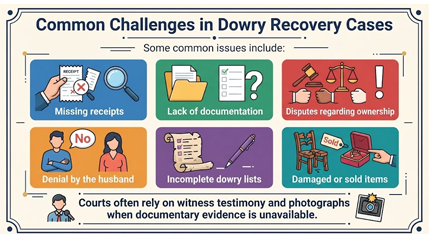
Common Challenges in Dowry Recovery Cases
Some common issues include:
- Missing receipts
- Lack of documentation
- Disputes regarding ownership
- Denial by the husband
- Incomplete dowry lists
- Damaged or sold items
Courts often rely on witness testimony and photographs when documentary evidence is unavailable.
Public Awareness: Protecting Dowry Rights
Families should maintain proper records of dowry items to avoid future disputes.
Recommended practices include:
- Preparing a written dowry list.
- Keeping purchase receipts.
- Taking photographs of valuable items.
- Maintaining digital records.
- Preserving wedding videos.
These measures can significantly strengthen a future legal claim if recovery becomes necessary.
Role of Family Court in Dowry Recovery Cases
Family Courts are empowered to:
- Hear dowry disputes.
- Record evidence.
- Assess ownership claims.
- Determine market value of articles.
- Pass recovery decrees.
- Enforce court orders.
The court aims to ensure that lawful property belonging to the wife is returned.
For official information regarding Pakistan’s judicial system and family law matters, readers may visit the Law and Justice Commission of Pakistan website.
Consult Advocate Uzair Rasheed for Dowry Recovery Cases in Pakistan
If you are facing issues regarding the recovery of dowry articles, jewelry, household goods, or other property after divorce, Khula, or separation, obtaining professional legal advice can help protect your legal rights. Advocate Uzair Rasheed provides legal assistance in Family Court matters, including Dowry Recovery, Khula, Divorce, Child Custody, Maintenance, and other family law disputes.
Whether you need legal consultation, case evaluation, document preparation, or representation before the Family Court, timely legal guidance can significantly improve your chances of a successful outcome.
Contact Information
📍 Office: Lahore High Court, Lahore, Pakistan
📞 Phone: +92 307 4834430
✉️ Email: legalinformationworld@gmail.com
🌐 Website: www.legalinformation.asia
▶️ YouTube: Legal Information Asia
Frequently Asked Questions
Can a wife recover dowry after Khula in Pakistan?
Yes. A woman can file a Dowry Recovery case even after obtaining Khula. Dowry rights are separate from Khula proceedings.
Which court handles Dowry Recovery cases?
Family Courts have jurisdiction to hear and decide Dowry Recovery matters.
Are receipts necessary for Dowry Recovery?
Receipts are helpful but not mandatory. Photographs, videos, and witness testimony can also support a claim.
Can jewelry be included in a Dowry Recovery case?
Yes. Gold jewelry, bridal ornaments, and other valuable items may be included.
What happens if the dowry items are sold or destroyed?
The court may order payment of the market value of those items instead of their physical return.
How long does a Dowry Recovery case take?
The duration varies depending on the evidence, court workload, and complexity of the dispute.
.
Conclusion
Dowry Recovery in Pakistan is an important legal remedy available to women whose dowry articles are withheld after separation, divorce, or Khula. Proper documentation, strong evidence, and timely legal action can significantly improve the chances of success. Public awareness regarding dowry rights helps protect women from financial loss and ensures access to legal remedies provided under Pakistani family laws.