

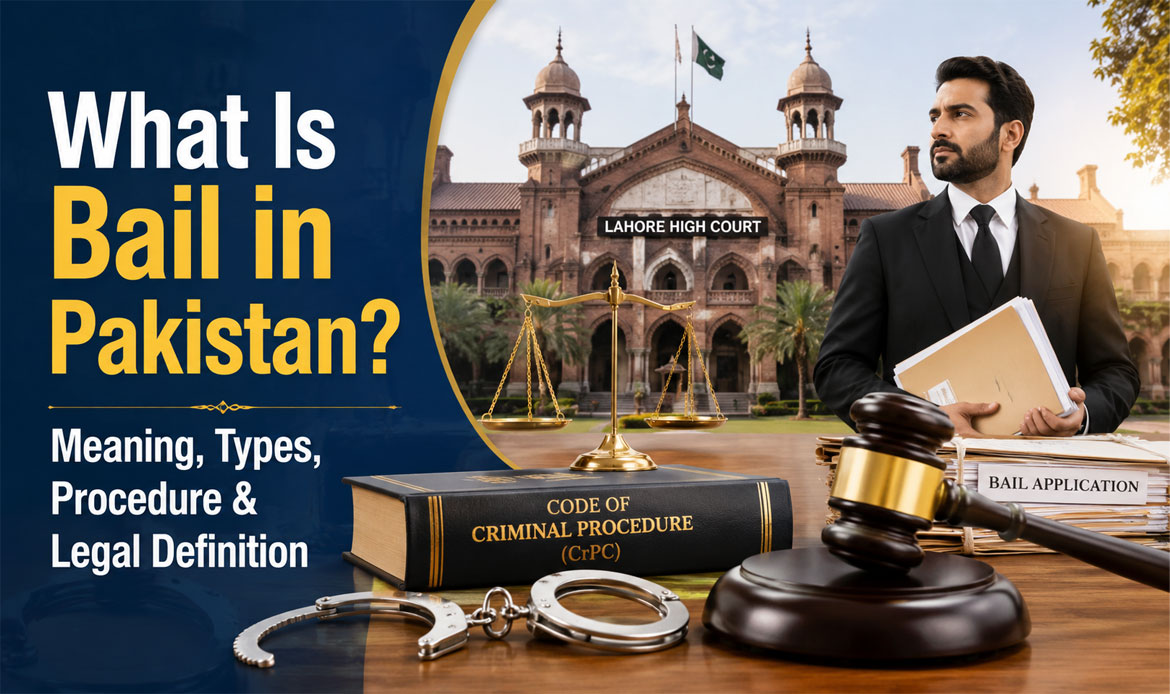
What Is Bail? Meaning, Legal Definition & Bail Procedure in Pakistan
Bail is one of the most important legal rights available to an accused person under Pakistani criminal law. It allows an individual to remain free while their criminal case is pending before the court, provided they meet certain legal conditions. Understanding what is bail in Pakistan is essential for anyone facing criminal charges or seeking legal information.
Whether the offence is bailable or non-bailable, the court considers several legal factors before granting bail. This guide explains the meaning of bail, its legal definition, different types, the bail procedure in Pakistan, eligibility, relevant laws, and frequently asked questions.
What is bail in Pakistan?
Bail is the temporary release of an accused person from police or judicial custody while their criminal case is pending before the court. The accused promises to appear before the court whenever required and comply with all conditions imposed by the judge.
The primary purpose of bail is to balance the rights of the accused with the interests of justice. Bail does not mean the accused has been declared innocent. It simply allows the accused to remain free until the court reaches a final decision.
Legal Definition of Bail
Legally, bail refers to the release of an accused person upon furnishing a bond, surety, or other security to ensure their appearance before the court whenever required.
In Pakistan, bail is mainly governed by the Code of Criminal Procedure, 1898 (CrPC), particularly Sections 496 to 498.
The courts have consistently held that:
“Bail is a rule, while jail is an exception” in appropriate circumstances, especially where the accused is entitled to bail under the law.
Meaning of Bail in Simple Words
In simple terms, bail means:
- Temporary freedom from custody.
- Permission to stay out of jail until the case is decided.
- A legal promise to attend every court hearing.
- A guarantee that the accused will cooperate with the investigation and trial.
Purpose of Bail in Pakistan
The objectives of granting bail include:
- Protecting the constitutional rights of the accused.
- Preventing unnecessary detention.
- Ensuring attendance before the court.
- Avoiding overcrowding in prisons.
- Maintaining the presumption of innocence until proven guilty.
- Allowing the accused to prepare their legal defence properly.
Laws Governing Bail in Pakistan
Several laws regulate bail proceedings in Pakistan.
Code of Criminal Procedure, 1898
The CrPC contains the primary legal provisions regarding bail.
Important sections include:
- Section 496 – Bail in bailable offences
- Section 497 – Bail in non-bailable offences
- Section 498 – Powers of High Court and Sessions Court to grant bail
Constitution of Pakistan
Article 9 protects the right to life and liberty.
Courts often consider constitutional protections while deciding bail applications.
Pakistan Penal Code (PPC)
Although the PPC defines criminal offences rather than bail itself, the nature and punishment of an offence under the PPC significantly influence whether bail may be granted.
Types of Bail in Pakistan
Several forms of bail exist under Pakistani law.
-
Pre-Arrest Bail
Also called anticipatory bail.
It protects a person who fears unlawful arrest due to false or malicious allegations.
-
Post-Arrest Bail
This is the most common type of bail.
It is filed after the accused has been arrested.
-
Protective Bail
Granted temporarily so an accused can approach the appropriate court.
-
Interim Bail
Temporary relief granted until the court finally decides the bail application.
-
Confirmatory Bail
When interim bail is confirmed after hearing both parties.
Bailable and Non-Bailable Offences
Bailable Offences
In these offences, the accused generally has a legal right to obtain bail.
Examples include:
- Minor assault
- Simple hurt
- Defamation
- Public nuisance
- Minor property offences
Non-Bailable Offences
In non-bailable offences, bail is granted only at the court’s discretion.
Examples include:
- Murder
- Terrorism
- Kidnapping
- Rape
- Serious narcotics offences
- Armed robbery
Who Can Apply for Bail?
The following persons may apply:
- The accused
- Legal heirs (in limited situations)
- Advocate on behalf of the accused
- Authorized legal representative
Eligibility for Bail in Pakistan
Courts examine several factors before granting bail.
Eligibility Criteria
- Nature of the offence
- Maximum punishment
- Available evidence
- Criminal record
- Possibility of absconding
- Chances of tampering with evidence
- Risk of influencing witnesses
- Medical condition
- Age of the accused
- Delay in trial
Documents Required for Bail
Usually, the following documents are required:
- Copy of FIR
- CNIC of accused
- Bail application
- Power of Attorney (through lawyer)
- Copies of relevant court documents
- Surety documents
- Property documents (where applicable)
- Affidavit
- Supporting evidence
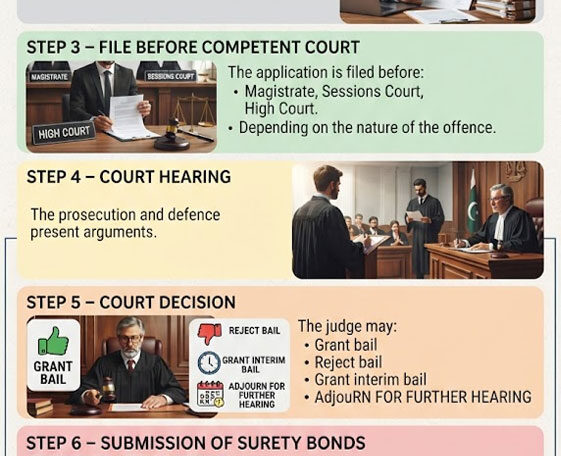
Step-by-Step Bail Procedure in Pakistan
Step 1 – Consult a Lawyer
An experienced criminal lawyer reviews the FIR and legal grounds.
Step 2 – Prepare Bail Application
The advocate drafts the bail petition.
Step 3 – File Before Competent Court
The application is filed before:
- Magistrate
- Sessions Court
- High Court
Depending on the nature of the offence.
Step 4 – Court Hearing
The prosecution and defence present arguments.
Step 5 – Court Decision
The judge may:
- Grant bail
- Reject bail
- Grant interim bail
- Adjourn for further hearing
Step 6 – Submission of Surety Bonds
If bail is granted, sureties furnish the required bonds.
Step 7 – Release Order
The jail authorities release the accused after verification.
Factors Courts Consider Before Granting Bail
Pakistani courts usually examine:
- Seriousness of allegations
- Strength of prosecution evidence
- Delay in registration of FIR
- Delay in trial
- Recovery of incriminating evidence
- Previous criminal history
- Possibility of fleeing
- Public interest
- Conduct of the accused
When Can Bail Be Refused?
The court may refuse bail if:
- Strong evidence exists.
- The offence carries severe punishment.
- The accused may abscond.
- Witnesses are likely to be threatened.
- Evidence may be destroyed.
- Previous bail conditions were violated.
Can Bail Be Cancelled?
Yes.
The court may cancel bail if:
- Bail conditions are violated.
- The accused commits another offence.
- The accused threatens witnesses.
- False information was provided.
- The accused absconds.
- The investigation is obstructed.
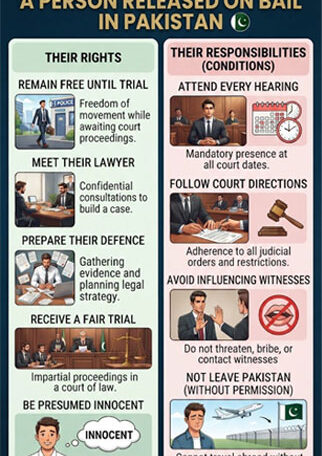
Rights of a Person Released on Bail
A person released on bail has the right to:
- Remain free until trial.
- Meet their lawyer.
- Prepare their defence.
- Receive a fair trial.
- Be presumed innocent until proven guilty.
However, they must:
- Attend every hearing.
- Follow court directions.
- Avoid influencing witnesses.
- Not leave Pakistan without permission if restricted.
Common Mistakes During Bail Applications
Many bail applications fail because applicants:
- File before the wrong court.
- Submit incomplete documents.
- Ignore legal requirements.
- Conceal important facts.
- Miss court hearings.
- Hire inexperienced legal representation.
Importance of Hiring an Experienced Bail Lawyer
A skilled criminal lawyer can:
- Assess whether bail is legally available.
- Prepare a strong bail petition.
- Present persuasive legal arguments.
- Protect the accused’s constitutional rights.
- Represent the accused effectively before the court.
Why Choose Uzair Rasheed Sandhu Advocate High Court for Bail Cases?
Uzair Rasheed Sandhu, Advocate High Court, provides professional and reliable legal representation for bail matters throughout Pakistan. Whether you require pre-arrest bail, post-arrest bail, protective bail, or interim bail, our experienced legal team is committed to protecting your constitutional rights and ensuring that every bail application is prepared with precision and presented effectively before the competent court.
We carefully assess the facts of each case, review the FIR and available evidence, prepare comprehensive bail petitions, and represent clients before Magistrate Courts, Sessions Courts, and the High Courts. Our objective is to secure timely relief while ensuring full compliance with the Code of Criminal Procedure, 1898, and other applicable laws.
With years of experience in criminal litigation, we provide strategic legal advice, maintain complete confidentiality, and offer personalized representation for clients across Pakistan, including overseas Pakistanis seeking legal assistance.
When You Choose Us
- Experienced representation in pre-arrest, post-arrest, interim, and protective bail cases.
- Thorough review of the FIR, investigation records, and legal grounds before filing the bail application.
- Accurate preparation and filing of bail petitions and supporting legal documents.
- Strong courtroom advocacy before Magistrate, Sessions, and High Courts.
- Practical legal guidance tailored to the specific facts and applicable laws of your case.
- Confidential, professional, and client-focused legal services.
- Timely updates and transparent communication throughout the legal process.
- Assistance for clients residing outside Pakistan through secure document handling and remote legal support.
- Comprehensive legal representation from the initial consultation until the final disposal of the bail matter.
Contact & Booking
For trusted and professional Bail Legal Services in Pakistan, contact our office today. We handle every case with diligence, legal precision, confidentiality, and prompt action.
📍 Office: Lahore High Court, Lahore, Pakistan
📞 Phone: +92 307 4834430
✉️ Email: legalinformationworld@gmail.com
🌐 Website: www.legalinformation.asia
FAQs
What is bail in Pakistan?
Bail is the temporary release of an accused person from custody while their criminal case is pending, subject to conditions imposed by the court.
Is bail a declaration of innocence?
No. Bail does not determine guilt or innocence. It only allows temporary release until the trial concludes.
Can bail be granted in murder cases?
Yes, depending on the facts, available evidence, and applicable legal provisions. The court decides each case individually.
Which court grants bail?
Depending on the case, bail may be granted by:
- Magistrate
- Sessions Court
- High Court
Can bail be cancelled after being granted?
Yes. Courts may cancel bail if the accused violates bail conditions or interferes with the administration of justice.
Conclusion
Understanding what is bail in Pakistan is essential for anyone involved in criminal proceedings. Bail protects the liberty of an accused person while ensuring that they remain available for investigation and trial. Pakistani courts decide bail applications after carefully considering the facts, applicable laws, and the interests of justice.
If you or a family member requires legal assistance regarding bail, consulting an experienced criminal lawyer at the earliest opportunity can help protect your legal rights and improve the chances of a successful bail application.