

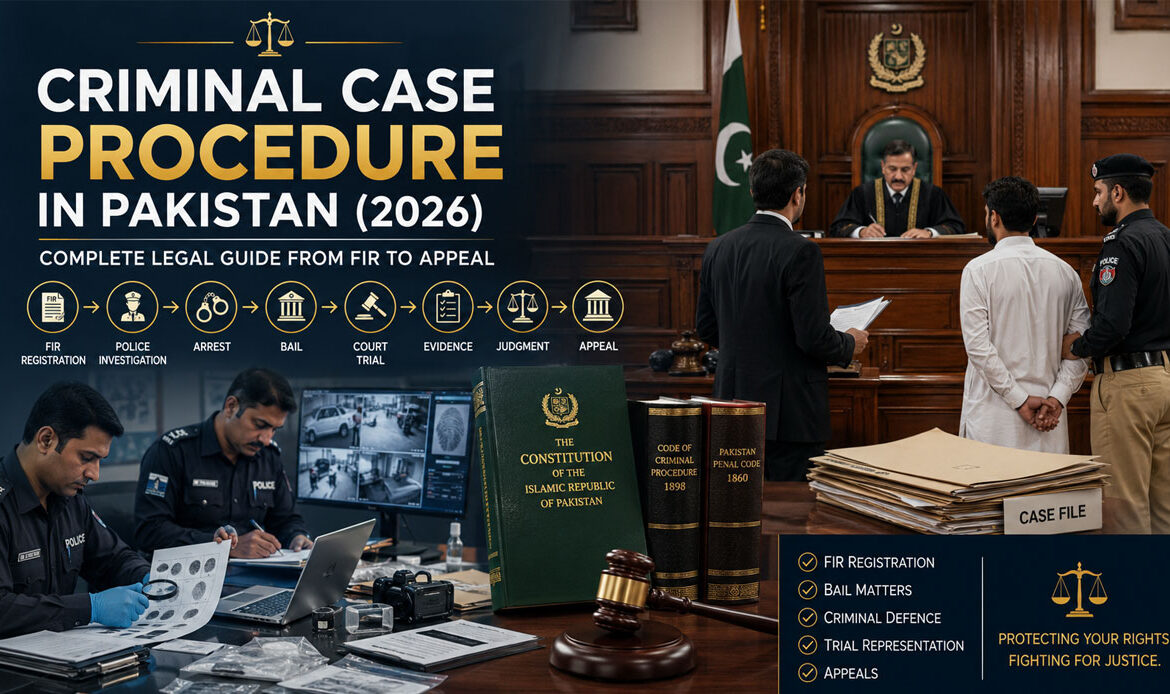
Criminal Case Procedure in Pakistan: A Complete Legal Guide (2026)
Understanding the criminal case procedure in Pakistan is essential for anyone involved in a criminal matter—whether as a complainant, accused person, witness, or family member. Criminal proceedings follow a structured legal framework designed to ensure justice while protecting the rights of all parties.
This comprehensive guide explains every stage of a criminal case in Pakistan, including FIR registration, police investigation, arrest, bail, trial, judgment, appeals, and the role of criminal lawyers.
What is a Criminal Case?
A criminal case is a legal proceeding initiated when a person is accused of committing an offence punishable under Pakistani law. The State prosecutes the accused because crimes are considered offences against society.
Criminal cases may involve:
- Murder
- Theft
- Robbery
- Fraud
- Cybercrime
- Assault
- Kidnapping
- Domestic violence
- Narcotics offences
- Financial crimes
Laws Governing Criminal Cases in Pakistan
Criminal proceedings are primarily governed by:
- Code of Criminal Procedure, 1898 (CrPC)
- Pakistan Penal Code, 1860 (PPC)
- Qanun-e-Shahadat Order, 1984
- Anti-Terrorism Act (where applicable)
- Prevention of Electronic Crimes Act (PECA), 2016
- Control of Narcotic Substances Act
- Other special criminal laws
Types of Criminal Cases
Criminal offences generally fall into two categories:
Cognizable Offences
Police can register an FIR and arrest without prior court permission.
Examples include:
- Murder
- Robbery
- Kidnapping
- Rape
- Serious assault
Minor Offences Requiring Court Permission
Police generally require court permission before beginning formal investigation.
Examples include:
- Minor assault
- Defamation
- Public nuisance (certain cases)
Step-by-Step Criminal Case Procedure in Pakistan
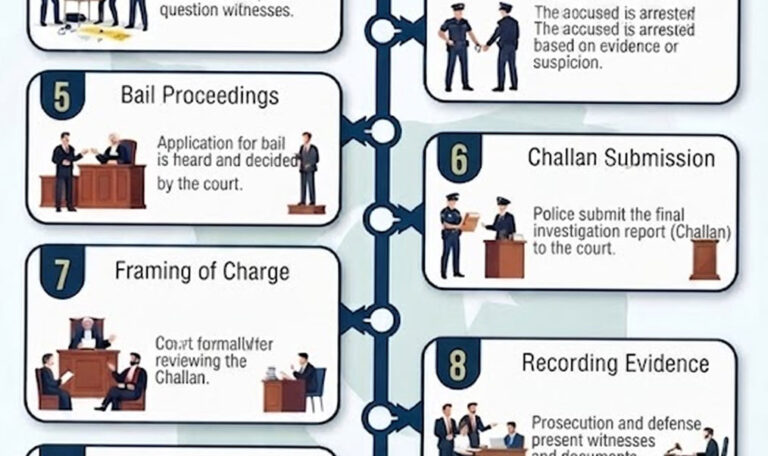
The criminal justice process usually follows these stages:
- Complaint
- FIR Registration
- Police Investigation
- Arrest (if necessary)
- Bail Proceedings
- Challan Submission
- Framing of Charge
- Recording Evidence
- Final Arguments
- Judgment
- Appeal
Let’s understand each stage in detail.
Stage 1: Registration of FIR
The first step in most criminal cases is the registration of a First Information Report (FIR) at the relevant police station.
The FIR contains:
- Name of complainant
- Date and time of occurrence
- Place of incident
- Details of accused (if known)
- Nature of offence
- Witness information
Once the FIR is registered, police formally begin the criminal investigation.
Stage 2: Police Investigation
After FIR registration, the investigating officer:
- Visits the crime scene
- Records witness statements
- Collects evidence
- Obtains forensic reports (where necessary)
- Reviews CCTV footage
- Recovers relevant documents
- Conducts arrests if required
Stage 3: Arrest of the Accused
Police may arrest an accused person where permitted by law.
After arrest:
- Grounds of arrest should be communicated.
- The accused is produced before a Magistrate within the legally prescribed period.
- The court examines whether police custody or judicial custody is appropriate.
Stage 4: Bail Procedure
Bail allows the accused to remain at liberty while the criminal case proceeds.
Types of bail include:
Pre-Arrest Bail
Applied for before arrest where there is apprehension of wrongful arrest.
Post-Arrest Bail
Applied after arrest.
Protective Bail
Granted temporarily to enable the accused to approach the appropriate court.
The court considers:
- Nature of offence
- Available evidence
- Criminal history
- Risk of absconding
- Possibility of influencing witnesses
Stage 5: Submission of Challan
Once the investigation is complete, police submit a challan (police report) before the competent court.
The challan generally includes:
- Investigation findings
- Witness list
- Documentary evidence
- Medical reports
- Forensic reports
- Recovery memos
- Expert opinions
The court then decides whether sufficient grounds exist to proceed with trial.
Stage 6: Court Proceedings
The trial court begins formal proceedings.
Important steps include:
- Appearance of accused
- Supply of prosecution documents
- Framing of charges
- Recording plea
- Fixing dates for evidence
The accused may plead guilty or claim trial.
Stage 7: Recording of Evidence
This is one of the most important stages.
The prosecution presents:
- Eye witnesses
- Police witnesses
- Medical experts
- Forensic experts
- Documentary evidence
- Digital evidence
- CCTV footage
- Expert reports
The defence has the right to cross-examine prosecution witnesses.
After prosecution evidence closes, the accused may:
- Record a statement
- Produce defence witnesses
- Present documentary evidence
Stage 8: Final Arguments
Both parties present legal arguments before the court.
The prosecution attempts to prove guilt beyond reasonable doubt.
The defence highlights:
- Weak evidence
- Contradictions
- False implication
- Lack of proof
- Procedural irregularities
Stage 9: Judgment
After evaluating all evidence, the court delivers its judgment.
Possible outcomes include:
- Conviction
- Acquittal
- Discharge
- Fine
- Imprisonment
- Compensation (where applicable)
The judgment explains the reasons supporting the court’s decision.
Stage 10: Appeal
A dissatisfied party may challenge the judgment before a higher court.
Depending on the case, appeals may lie before:
- Sessions Court
- High Court
- Supreme Court of Pakistan
Appeals must generally be filed within the prescribed legal limitation period.
Rights of the Accused
Every accused person enjoys important legal protections, including:
- Presumption of innocence
- Right to legal representation
- Right to a fair trial
- Right to remain silent where applicable
- Right to cross-examine witnesses
- Right to present defence evidence
- Right to appeal
- Protection against unlawful detention
Rights of the Complainant
The complainant also has important legal rights:
- Registration of FIR where legally justified
- Fair investigation
- Participation during trial
- Protection of witnesses where applicable
- Access to legal remedies
- Right to appeal in appropriate circumstances
Throughout the Criminal Case Procedure in Pakistan, the law protects the rights of both the accused and the complainant to ensure a fair and transparent judicial process.
Common Reasons Criminal Cases Are Delayed
Several factors may delay criminal proceedings:
- Non-appearance of witnesses
- Pending forensic reports
- Police investigation delays
- Frequent adjournments
- Heavy court workload
- Complex evidence
- Multiple accused persons
Experienced legal representation can help minimize unnecessary delays.
Importance of Hiring an Experienced Criminal Lawyer
A qualified criminal lawyer can:
- Analyze evidence
- Apply for bail
- Challenge unlawful arrests
- Prepare legal defence
- Cross-examine witnesses
- Protect constitutional rights
- File appeals
- Represent clients before all criminal courts
Professional legal advice often makes a significant difference in the outcome of criminal proceedings.

Why Choose Advocate Uzair Rasheed Sandhu?
If you are facing a criminal investigation or need legal representation, Advocate Uzair Rasheed Sandhu, High Court Advocate, provides professional legal services throughout Pakistan.
Our legal services include:
- FIR Registration Assistance
- Criminal Defence
- Bail Matters
- Trial Representation
- Appeals
- White-Collar Crime Cases
- Cyber Crime Cases
- Fraud Cases
- Police Investigation Matters
We are committed to protecting your legal rights with professionalism, confidentiality, and strategic representation.
If you are involved in the Criminal Case Procedure in Pakistan, obtaining legal advice from an experienced criminal lawyer can help protect your rights and improve your chances of a favorable outcome.
Contact Us
For trusted and professional Criminal Case Legal Services in Pakistan, contact our office today. We handle every case with diligence, legal precision, and confidentiality.
Office: Lahore High Court, Lahore, Pakistan
Phone: +92 307 4834430
Email: legalinformationworld@gmail.com
Website: https://legalinformation.asia
FAQs
How long does a criminal case take in Pakistan?
The duration depends on the nature of the offence, evidence, witness availability, and court workload. Some cases conclude within months, while others may take several years.
Can an FIR be cancelled?
Yes. If the investigation finds no evidence supporting the allegations, the police may recommend cancellation, subject to the court’s consideration where required.
Is bail available in every criminal case?
No. Bail depends on the offence, applicable law, available evidence, and judicial discretion.
Can criminal cases be settled outside court?
Certain offences may be compounded under Pakistani law, while others cannot be settled privately because they involve offences against the State.
What happens if the accused is found innocent?
The court may acquit the accused if the prosecution fails to prove guilt beyond reasonable doubt.
Conclusion
Understanding the criminal case procedure in Pakistan empowers individuals to protect their legal rights and navigate the justice system effectively. From FIR registration and police investigation to trial, judgment, and appeal, each stage is governed by established legal procedures aimed at ensuring fairness and due process. Seeking timely advice from an experienced criminal lawyer can significantly improve case management and help safeguard your interests throughout the proceedings.