

Property Inheritance Law in Pakistan: Complete Guide
Property inheritance is one of the most important legal matters that families face after the death of a loved one. Understanding Property Inheritance Law in Pakistan helps ensure that a deceased person’s assets are distributed fairly and lawfully among eligible heirs. Unfortunately, many inheritance disputes arise because family members are unaware of their legal rights or the proper legal procedure.
In Pakistan, inheritance is governed by a combination of Islamic principles and Pakistani laws. Whether the deceased leaves behind a house, agricultural land, commercial property, bank accounts, or other assets, the distribution must follow the applicable legal framework.
This guide explains the Property Inheritance Law in Pakistan, including who can inherit property, how inheritance shares are calculated, the legal procedure for transferring inherited property, the rights of women, required documents, succession certificates, and practical steps to resolve inheritance disputes.
What Is Property Inheritance Law in Pakistan?
Property Inheritance Law in Pakistan refers to the legal rules governing the transfer of a deceased person’s assets to their lawful heirs. These laws determine who is entitled to inherit property, the proportion each heir receives, and the legal procedure for transferring ownership.
Inheritance may include:
- Residential houses
- Agricultural land
- Commercial properties
- Apartments and plots
- Bank accounts
- Vehicles
- Business assets
- Investments
- Gold and jewellery
- Other movable and immovable property
The purpose of inheritance law is to protect the rights of legal heirs, prevent unlawful occupation of property, and ensure that the deceased’s estate is distributed according to the law.
Legal Framework Governing Property Inheritance in Pakistan
Inheritance matters in Pakistan are regulated through a combination of Islamic law and statutory laws. Courts apply these legal principles depending on the religion and circumstances of the deceased.
The primary legal sources include:
Islamic Law (Shariah)
For Muslims, inheritance is generally distributed according to the Holy Quran and Sunnah. Fixed inheritance shares have been prescribed for eligible heirs, ensuring fairness and protecting the rights of family members.
Succession Act
For non-Muslims, inheritance may be governed by the applicable succession laws, depending on their faith and personal law.
Provincial Land Revenue Laws
These laws regulate the mutation and transfer of inherited land and property in the relevant provincial land records.
Civil Court Procedures
Where disputes arise regarding ownership, entitlement, or distribution, civil courts decide inheritance cases according to the applicable law and available evidence.
Why Property Inheritance Law Is Important
Understanding inheritance law helps families avoid lengthy legal disputes and protects the rights of all eligible heirs.
Proper legal knowledge can help:
- Prevent illegal occupation of inherited property.
- Protect women’s inheritance rights.
- Reduce family conflicts.
- Ensure lawful property transfer.
- Avoid fraudulent documentation.
- Facilitate smooth mutation of inherited property.
- Secure ownership of inherited assets.
Islamic Principles of Property Inheritance
Islam places great importance on justice when distributing property after death. Unlike many legal systems that leave inheritance entirely to personal choice, Islamic law provides fixed shares for many close relatives.
Generally, the estate is distributed in the following order:
- Funeral and burial expenses.
- Outstanding debts of the deceased.
- Any valid will (subject to legal limits).
- Distribution of the remaining estate among lawful heirs.
A person cannot deprive eligible heirs of their prescribed inheritance shares through a will.
Who Can Inherit Property in Pakistan?
The legal heirs depend on the family structure and the applicable law. Common heirs may include:
- Husband or wife
- Sons
- Daughters
- Father
- Mother
- Grandchildren (in certain circumstances)
- Grandparents
- Brothers and sisters (where applicable)
- Other eligible relatives according to Islamic inheritance principles
The exact inheritance share of each heir varies depending on which family members survive the deceased.
Legal Heirs Under Property Inheritance Law in Pakistan
The following relatives are commonly recognized as legal heirs:
Husband
A husband may inherit from his deceased wife’s estate according to Islamic inheritance rules.
Wife
A widow has a legally protected share in her husband’s estate. No family member can lawfully deprive her of this right.
Sons
Sons are among the primary legal heirs and generally receive a larger share than daughters under Islamic inheritance principles.
Daughters
Daughters have a legally protected right to inherit property. Denying a daughter her inheritance is unlawful and may give rise to legal proceedings.
Parents
Both the father and mother may inherit from their deceased child according to the applicable inheritance rules.
Other Relatives
Where closer heirs are absent, inheritance may pass to other eligible relatives according to the prescribed legal principles.
Rights of Women Under Property Inheritance Law in Pakistan
Women’s inheritance rights are protected under both Islamic law and Pakistani law. A daughter, wife, or mother cannot be lawfully deprived of her inheritance simply because of cultural practices or family pressure.
If a woman is denied her rightful share, she may seek legal remedies through the competent court to enforce her inheritance rights.
Protecting women’s inheritance rights promotes fairness, strengthens families, and upholds the principles of justice recognized by the legal system.
Common Mistakes Families Make
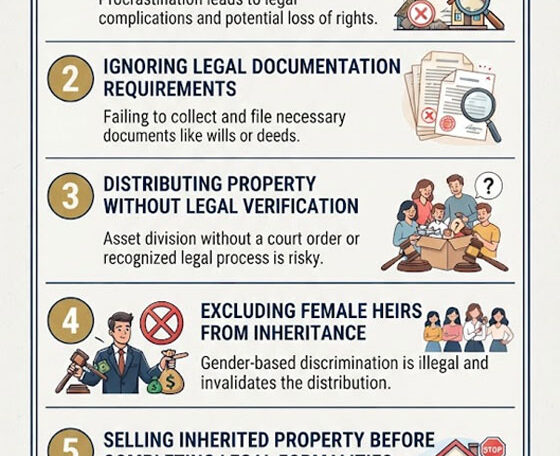
Many inheritance disputes arise because families make avoidable mistakes, such as:
- Delaying the transfer of inherited property.
- Ignoring legal documentation requirements.
- Distributing property without legal verification.
- Excluding female heirs from inheritance.
- Selling inherited property before completing legal formalities.
- Failing to resolve ownership disputes through lawful procedures.
Seeking timely legal guidance can help prevent these issues and ensure that inheritance is distributed in accordance with the law.
Rights of Sons and Daughters Under Property Inheritance Law in Pakistan
One of the most frequently asked questions about Property Inheritance Law in Pakistan is how property is divided between sons and daughters. Under Islamic inheritance principles applicable to Muslims, both sons and daughters have a legal right to inherit property. The exact share depends on the surviving heirs and the family structure.
It is important to note that no legal heir can arbitrarily change or deny the prescribed inheritance shares. Any attempt to deprive an eligible heir—especially a daughter—may be challenged before the competent court.
Key Points
- Sons and daughters are both legal heirs.
- Female heirs cannot be forced to relinquish their inheritance.
- Property distribution must follow the applicable legal principles.
- Family agreements should not violate the lawful rights of eligible heirs.
Rights of a Widow and Widower
The surviving spouse is also entitled to inherit from the deceased’s estate.
Widow’s Rights
A widow has a legally protected share in her husband’s property. Her inheritance rights extend to:
- Residential property
- Agricultural land
- Commercial property
- Bank accounts
- Investments
- Other movable and immovable assets
No family member has the legal authority to exclude a widow from her inheritance.
Widower’s Rights
A husband also inherits from his deceased wife’s estate according to the applicable inheritance rules.
Parents’ Inheritance Rights
Parents are among the closest legal heirs.
A father or mother may inherit from their deceased son or daughter, depending on the surviving family members and the applicable legal rules.
Parents’ rights are protected by law and cannot be ignored during the distribution of the estate.
What Happens If There Is No Will?
Many people believe that property cannot be distributed if the deceased did not leave a will. This is incorrect.
If no valid will exists, the estate is distributed among the legal heirs according to the applicable inheritance laws. The court or relevant authority determines the rightful heirs and facilitates the legal transfer of property where required.
Difference Between a Will (Wasiyat), Gift (Hiba), and Inheritance
Understanding the distinction between these concepts is essential.
Will (Wasiyat)
A will is a written declaration expressing how certain assets should be distributed after death, subject to the legal limitations imposed by applicable law.
Gift (Hiba)
A gift is the voluntary transfer of property during the lifetime of the owner. Once a valid gift is completed, the property generally no longer forms part of the deceased’s estate.
Inheritance
Inheritance is the legal transfer of a deceased person’s estate to eligible heirs after fulfilling funeral expenses, outstanding debts, and any valid testamentary obligations.
Succession Certificate in Pakistan
A Succession Certificate is often required to establish the legal entitlement of heirs to certain movable assets, such as:
- Bank accounts
- Cash deposits
- Shares and securities
- Pension benefits (where applicable)
- Other financial assets
The certificate confirms the identity of the lawful heirs and authorizes them to claim the deceased’s movable property.
Letter of Administration
Where immovable property or certain assets require formal administration, the competent court may issue a Letter of Administration.
This document authorizes the legal representative to administer, manage, or transfer the estate according to law.
Documents Required for Property Inheritance
The required documents may vary depending on the circumstances, but commonly include:
- Death Certificate of the deceased
- Computerized National Identity Cards (CNICs) of all legal heirs
- Family Registration Certificate (FRC), where applicable
- Property ownership documents
- Title deeds or registry documents
- Latest property tax records (if available)
- Succession Certificate or Letter of Administration (where required)
- Affidavits or court orders, if applicable
- Family Registration Certificate (FRC) issued by NADRA
Preparing complete documentation helps avoid unnecessary delays in the inheritance process.
Court Procedure for Property Inheritance
If the heirs cannot settle the matter amicably or if legal documentation is required, the inheritance process may involve the competent court.
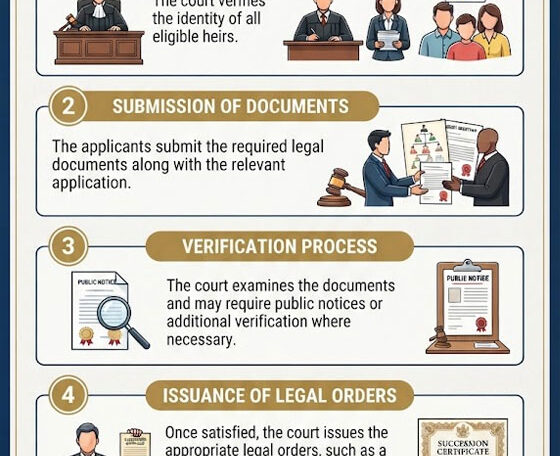
The general procedure includes:
Step 1 – Identification of Legal Heirs
The court verifies the identity of all eligible heirs.
Step 2 – Submission of Documents
The applicants submit the required legal documents along with the relevant application.
Step 3 – Verification Process
The court examines the documents and may require public notices or additional verification where necessary.
Step 4 – Issuance of Legal Orders
Once satisfied, the court issues the appropriate legal orders, such as a Succession Certificate or Letter of Administration, depending on the nature of the estate.
Step 5 – Property Transfer
The heirs can then proceed with the mutation or transfer of the inherited property before the relevant authority.
Property Mutation After Inheritance
After completing the legal process, inherited property should be mutated in the land records to reflect the names of the lawful heirs.
Mutation is important because it:
- Updates the official ownership record.
- Protects the rights of the legal heirs.
- Reduces the likelihood of future disputes.
- Facilitates the lawful sale, transfer, or mortgage of the property.
Failure to complete the mutation process can create complications in future transactions.
Common Property Inheritance Disputes
Inheritance disputes are unfortunately common in Pakistan. Some of the most frequent issues include:
- Not giving women their legal inheritance rights.
- Fake property documents
- Illegal occupation of inherited property.
- Disagreements regarding the distribution of shares.
- Sale of inherited property without the consent of all legal heirs.
- Delays in obtaining succession documents.
- Conflicts among siblings or extended family members.
Resolving these disputes promptly through legal channels can help preserve family relationships and protect the rights of all concerned.
How to Protect Your Inheritance Rights
To safeguard your legal rights, consider the following:
- Maintain complete property documentation.
- Obtain certified copies of ownership records.
- Complete the succession process without unnecessary delay.
- Ensure all legal heirs are properly identified.
- Avoid informal property transfers that bypass legal requirements.
- Seek qualified legal advice if a dispute arises.
- Complete the mutation process after inheritance is finalized.
Taking these steps can help ensure that inherited property is transferred lawfully and efficiently.
Why Choose Uzair Rasheed Sandhu Advocate High Court?
Property inheritance matters often involve complex legal procedures, documentation, succession certificates, property mutation, and disputes among legal heirs. Having an experienced legal professional by your side can help protect your rights and ensure that the inheritance process is completed efficiently and in accordance with Pakistani law.
Advocate Uzair Rasheed Sandhu, High Court Advocate, provides professional legal assistance in a wide range of inheritance and property matters, including:
- Property inheritance and succession cases
- Legal heir declarations
- Succession Certificates and Letters of Administration
- Property mutation (Warasat)
- Property transfer and ownership disputes
- Family settlement agreements
- Civil litigation related to inherited property
- Legal consultation for overseas Pakistanis
- Documentation, verification, and court representation
With a client-focused approach, transparent legal guidance, and extensive experience in property and family law matters, Advocate Uzair Rasheed Sandhu is committed to protecting the legal rights of every client. The firm strives to provide reliable, practical, and timely legal solutions for individuals and families throughout Pakistan.
Contact Information
Office: Lahore High Court, Lahore, Pakistan
Phone / WhatsApp: +92 307 4834430
Email: legalinformationworld@gmail.com
Website: Legal Information Asia
Whether you need advice regarding inheritance rights, property distribution, succession certificates, or inheritance disputes, you can contact Advocate Uzair Rasheed Sandhu for professional legal guidance tailored to your specific circumstances.
FAQs
What is Property Inheritance Law in Pakistan?
Property Inheritance Law in Pakistan governs how a deceased person’s assets are legally distributed among eligible heirs under Pakistani and Islamic law.
Who are the legal heirs in Pakistan?
Legal heirs generally include the spouse, sons, daughters, parents, and other eligible relatives, depending on the family circumstances.
Can daughters inherit property in Pakistan?
Yes. Daughters have a legal right to inherit property under Pakistani and Islamic law.
What documents are required for inheritance?
Common documents include the Death Certificate, CNICs of legal heirs, property documents, FRC (if applicable), and a Succession Certificate where required.
What is a Succession Certificate?
A Succession Certificate confirms the legal heirs and allows them to claim the deceased’s movable assets, such as bank accounts and investments.
Is a will necessary for inheritance?
No. If there is no valid will, the property is distributed according to the applicable inheritance laws.
How is inherited property transferred?
The property is transferred through the legal mutation process after completing the required documentation and legal formalities.
Can inheritance disputes be resolved in court?
Yes. If heirs disagree over inheritance, they can seek relief from the competent court.
Can brothers deny sisters their inheritance?
No. Sisters have a legal right to inherit property and cannot be lawfully deprived of their share.
Why should I hire an inheritance lawyer?
An inheritance lawyer can help with succession certificates, property transfer, legal documentation, and dispute resolution.
Conclusion
Understanding Property Inheritance Law in Pakistan is essential to ensure that a deceased person’s assets are distributed fairly and in accordance with Pakistani and Islamic law. Knowing your legal rights, completing the required documentation, and following the proper legal procedure can help prevent disputes and protect the interests of all eligible heirs.
If you need assistance with inheritance matters, succession certificates, property mutation, or inheritance disputes, seeking professional legal advice can make the process smoother and more efficient.
If you require legal assistance with inheritance or other family matters, explore our Family Law Services in Pakistan for comprehensive legal support.
For trusted legal guidance, contact Advocate Uzair Rasheed Sandhu, High Court Advocate.
📍 Office: Lahore High Court, Lahore, Pakistan
📞 Phone / WhatsApp: +92 307 4834430
✉️ Email: legalinformationworld@gmail.com
🌐 Website: www.legalinformation.asia
Whether you need legal consultation or representation in an inheritance case, Advocate Uzair Rasheed Sandhu is committed to protecting your legal rights with professional and reliable legal services.